

The rise of remote work has created a new category of taxpayers: digital nomads who maintain residency in one state while earning income in another: or multiple others. For the 2026 tax year, these individuals face complex filing obligations that extend far beyond a single Form 1040. Understanding the distinction between residency, domicile, and physical presence has become essential for anyone working across state lines.
Federal Tax Obligations Apply Regardless of Location
US citizens and green card holders must file federal income tax returns with the IRS regardless of where they physically work or reside. The United States employs citizenship-based taxation, meaning location does not exempt taxpayers from federal filing requirements. Digital nomads must report all income to the IRS, whether earned domestically or abroad.
For those working internationally, the Foreign Earned Income Exclusion (FEIE) provides significant tax relief. Taxpayers who qualify can exclude up to $128,100 of foreign-earned income from federal taxation for the 2026 tax year. Qualification requires meeting either the Physical Presence Test: being outside the United States for at least 330 days during any 12-month period: or the Bona Fide Residence Test, which establishes foreign residency for an entire tax year.
Most digital nomads who successfully claim the FEIE owe little or nothing in federal income tax. However, qualifying for this exclusion requires careful documentation and strategic planning regarding travel dates and work locations.
State Income Tax: The More Complicated Reality
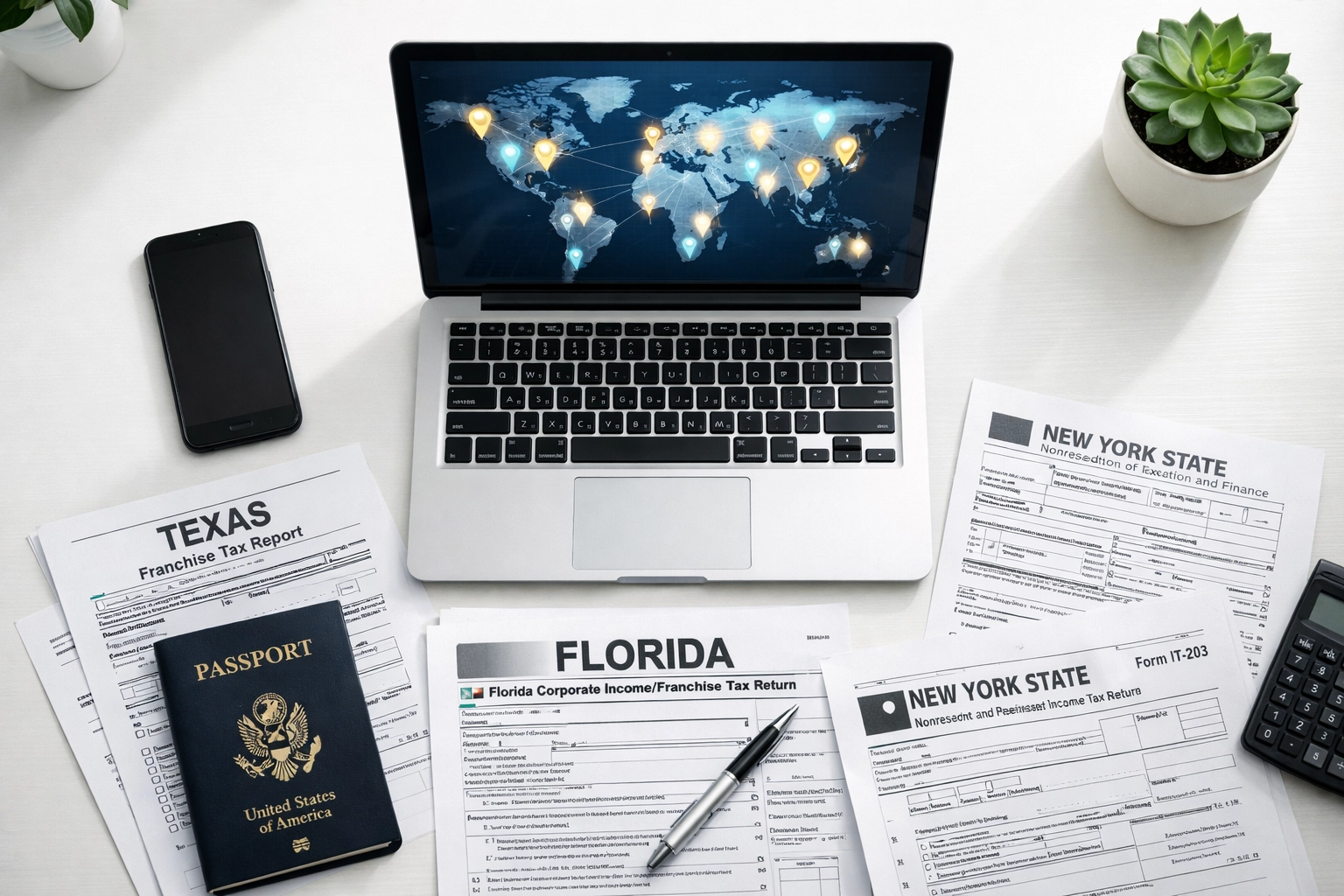
State tax obligations present the most challenging aspect of the digital nomad tax situation. Simply leaving a state does not automatically terminate tax obligations to that jurisdiction. States maintain the right to tax residents based on domicile: the place an individual considers their permanent home: rather than temporary physical location.
Establishing and Changing Domicile
Domicile represents the single location where a taxpayer maintains their permanent home with the intent to return. Changing domicile requires both physical relocation and demonstrable intent to make the new location a permanent residence. States examine multiple factors when determining domicile:
- Location of primary residence and property ownership
- Driver's license and vehicle registration addresses
- Voter registration status
- Location of bank accounts and financial institutions
- Professional licenses and business registrations
- Family location and school enrollment for dependents
- Time spent in each location throughout the year
Digital nomads must formally establish a new domicile before departure to avoid continued tax obligations in their former state. This process requires more than updating an address: it demands creating a paper trail that demonstrates genuine relocation intent.
The Strategic Advantage of No-Income-Tax States
States including Texas, Florida, Nevada, Washington, Wyoming, South Dakota, Tennessee, Alaska, and New Hampshire impose no state income tax on earned income. Digital nomads who establish domicile in these jurisdictions before beginning their traveling lifestyle eliminate state income tax obligations entirely.
However, establishing domicile in a no-income-tax state requires actual presence and intent. Taxpayers must secure housing, obtain state identification, register vehicles, and create legitimate ties to the jurisdiction. States with income tax systems actively pursue residents who attempt to claim domicile in tax-free states without genuine relocation.

Multi-State Income Requires Multi-State Filing
Digital nomads who work temporarily in states other than their domicile state may trigger filing requirements in those jurisdictions. Most states require nonresidents to file state income tax returns and pay tax on income earned within state borders if that income exceeds a minimum threshold: often as low as $1,000 annually.
Resident vs. Nonresident Returns
Taxpayers may need to file two categories of state returns:
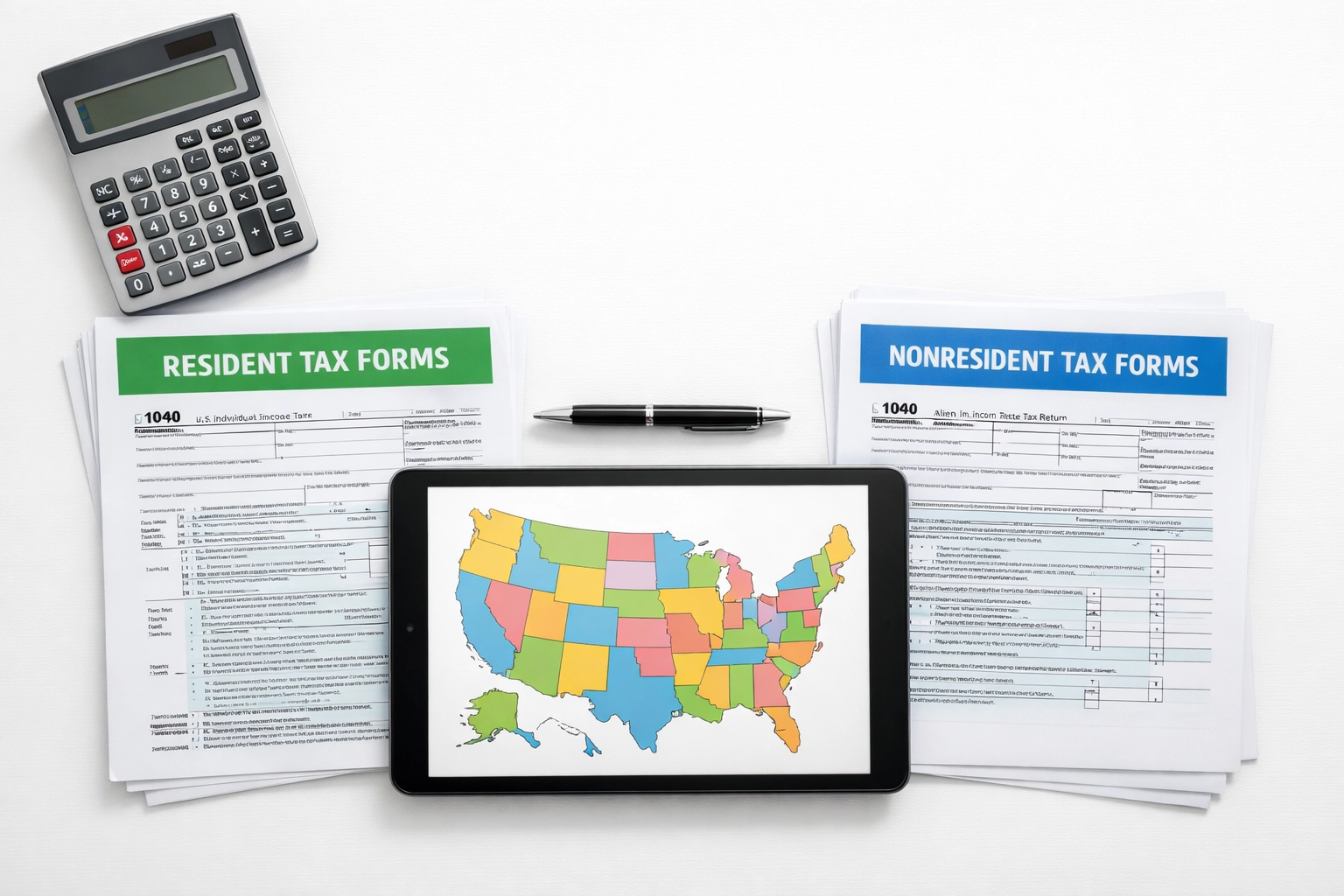
Resident returns report worldwide income to the state of domicile. The taxpayer's home state taxes all income regardless of where it was earned.
Nonresident returns report only the income earned while physically working within that state's borders. States tax nonresidents exclusively on income sourced to their jurisdiction.
This creates the possibility of double taxation on the same income. However, most states provide a credit for taxes paid to other states, preventing taxpayers from paying full tax twice on identical income. Digital nomads must track their physical location when earning income and maintain detailed records of days worked in each state.
Self-Employment Tax Obligations for Digital Nomads
Digital nomads working as independent contractors or business owners face additional federal tax requirements beyond standard income tax. Self-employment tax covers Social Security and Medicare contributions at a combined rate of approximately 15.3% on net self-employment earnings of $400 or more.
Unlike income tax, self-employment tax applies to foreign-earned income even when that income qualifies for the FEIE. Digital nomads cannot exclude self-employment earnings from Social Security and Medicare taxation, regardless of where the income was earned or how long they remained outside the United States.
Self-employed digital nomads must file Schedule SE with their Form 1040 to calculate self-employment tax liability. Those claiming the FEIE must also file Form 2555 to document their foreign earned income exclusion. If foreign income taxes were paid, Form 1116 may provide a credit against US tax liability.
Documentation Requirements and Record Keeping
Digital nomads bear the burden of proving their tax positions to both federal and state tax authorities. Comprehensive record keeping becomes essential for defending residency claims and income sourcing decisions.
Taxpayers should maintain the following documentation:
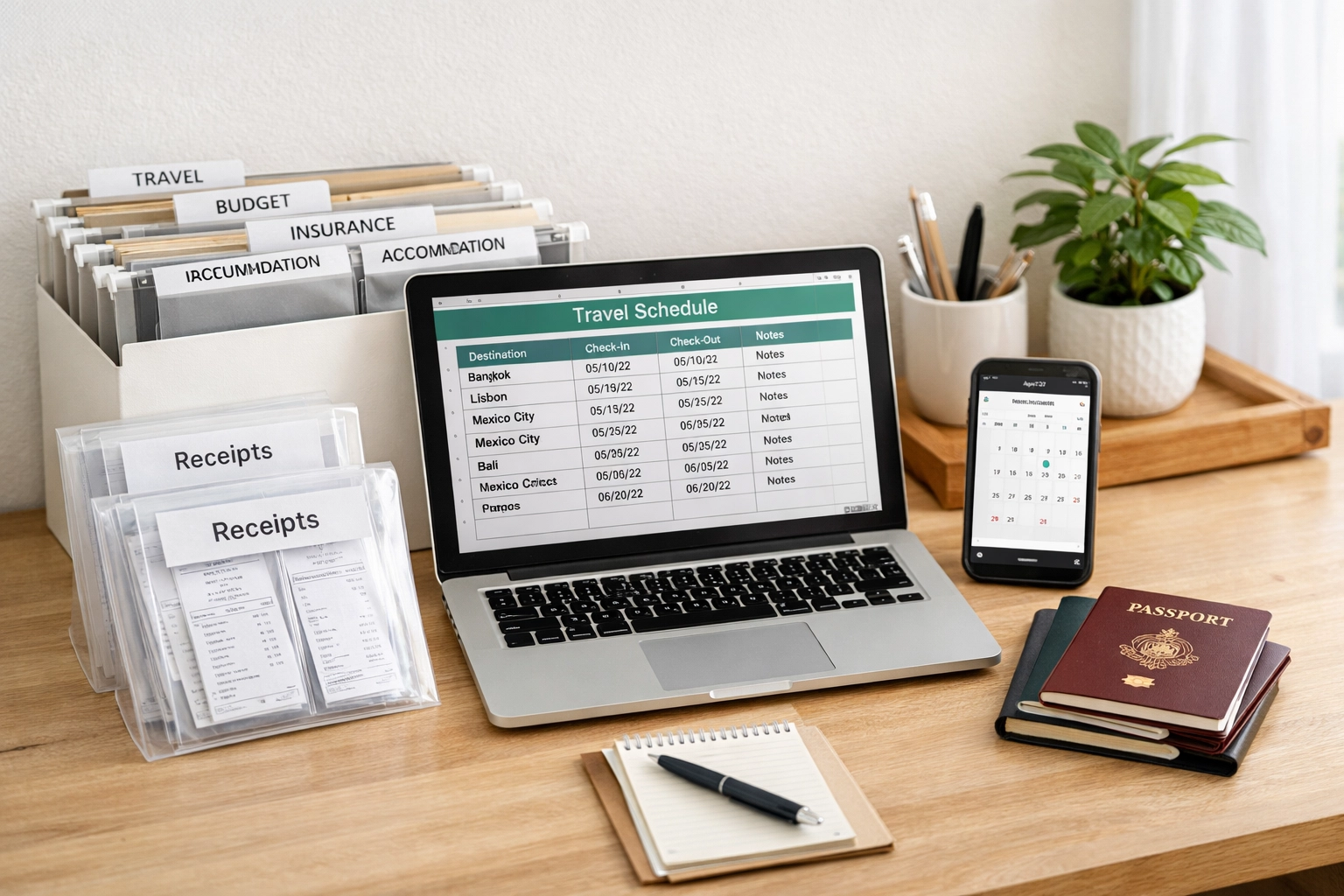
- Detailed travel logs showing dates and locations of travel
- Lease agreements, property deeds, and utility bills for all residences
- Bank statements and credit card records showing transaction locations
- Work contracts specifying where services were performed
- Receipts for housing, transportation, and business expenses
- Digital records of internet connection locations and work login data
- State identification documents, vehicle registrations, and voter records
- Professional correspondence establishing work location and client locations
Tax authorities increasingly use sophisticated data matching to verify taxpayer claims. Credit card transactions, mobile phone location data, and social media posts can all contradict stated positions regarding residency and work location.
Common Tax Filing Mistakes Digital Nomads Must Avoid
Digital nomads frequently encounter tax compliance problems due to misconceptions about their obligations. The most common errors include:
Assuming physical absence eliminates state tax obligations. Domicile continues until formally changed, regardless of time spent traveling or working elsewhere.
Failing to file nonresident returns in work states. Many digital nomads incorrectly believe working remotely eliminates filing requirements in states where clients are located or where they temporarily work.
Claiming the FEIE without meeting qualification tests. Brief international trips do not qualify for the foreign earned income exclusion, which requires either 330 full days outside the United States or bona fide foreign residence.
Neglecting self-employment tax on foreign income. The FEIE excludes income from income tax but not from self-employment tax obligations.
Changing mailing addresses without changing domicile. Using a relative's address or mail forwarding service does not establish domicile or change state tax obligations.
Planning Ahead: Establishing Residency Before Departure
Digital nomads should establish domicile in their chosen state before beginning extended travel. This process typically requires several months of actual presence in the new domicile state to create the necessary documentation and connections.
The residency establishment process should include:
- Securing housing through lease or property purchase
- Obtaining a driver's license and registering vehicles
- Registering to vote at the new address
- Opening local bank accounts
- Updating professional licenses and business registrations
- Filing a final resident return in the former state
- Filing a declaration of domicile if the new state offers this option
High-income digital nomads and those with significant assets should consult with tax professionals before making domicile changes. Some states aggressively audit high-income taxpayers who claim to have left the state, requiring extensive proof of genuine relocation.
Professional Guidance for Complex Situations
The intersection of federal tax law, state income tax regulations, and international tax treaties creates substantial compliance challenges for digital nomads. Individual circumstances: including income level, work structure, family situation, and travel patterns: significantly affect tax obligations and optimal filing strategies.
Tax professionals experienced in multi-state taxation can help digital nomads structure their arrangements to minimize tax liability while maintaining full compliance. Proactive planning prevents costly errors and positions taxpayers to defend their positions if questioned by tax authorities.
For digital nomads navigating these complex tax realities, professional assistance ensures proper reporting while maximizing available exclusions, deductions, and credits across all relevant jurisdictions.